Can you achieve mindblowing Page Load Speed if you axe WordPress?
The real shock of Page Load Speed hits you when you realize that bloated CMS website systems like WordPress, Drupal, and others are counterintuitive to your business success. And I must issue this warning: you're about to experience a real paradigm shift if you love visual drag-and-drop webpage builders.
In 2005, when we were tired of 9 years of needing to not only write the content but the HTML code to go with it, the idea of a content management system that would code for you was magic to the ears. No thought was given then to page load speed and other metrics, which makes sense, as the SEO industry was only just emerging from the dark ages.
The promise of only focusing on content sounded wonderful, and by 2010, all of our content was created and moved inside WordPress, which was much easier than what we had done from 1996 on.
Code Bloat
WordPress and drag-and-drop systems that run inside it, like Elementor Pro, add many lines of code that are often referred to as bloat. The size of these bloated files is much larger than normal static HTML, creating a real issue with page load speed.
That bloat slows down the loading of page speeds, creating the need for the Technical SEO industry. People get paid to compress code, reduce render blocking, and master the use of plugins like WP Rocket and Yoast just to speed up web page loading, which was far faster without the CMS system (in my case WordPress).
In the last few years, automation has evolved. Now, HTML templates containing JavaScript and markup (HTML) can be merged with content by a small Python program to create a web page that has zero render blocking and perfect SEO every time.
Not only are these perfect web pages that load many times faster (especially on mobile) than any web page created on CMS, but the process does not require loading a server resource-eating hog just to create the new content!
When you think about it, this new way to post content reduces the web server’s resources and thus should cost less. But let’s touch back on the details of future website hosting costs (“Spend Less, Sell More”) later.
Before moving on from talking about bloat, there are tons of posts on code bloat and this article cuts right to the quick of it:
“Static sites have much less bloat than a dynamic site. There are no plugins, no databases, and no wasted space on your site. WordPress sites have tons of messy, bloated code that makes it harder for your site to load.” - Limitless Web Design
Automation & Content Creation
Let’s use this web page was written in Google Docs, copied into a spreadsheet, and then a small program triggered three automations:
Rendering the content into a pre-existing HTML template and saving the output markup and JavaScript as a finished HTML file (a web page) Uploading the web page to the server in a ~/public_html folder. Uploading the images to be used in the new web page into ~/public_html/images, making them available to the new web page.
I never left my laptop, never manually logged into anything, and boom!
New content creation is that fast and so easy.
By comparison, with WordPress and Elementor Pro, I still had to write the content, but then I would need to log into WordPress, load Elementor Pro, and load a template, only then would I be ready to paste the content into it. This process typically took me twenty minutes, and most would consider me a pro!
Again, since writing content takes the same time no matter what system you use to deliver content, the comparison is twenty minutes vs 15 seconds with that system I now use!
Content Automation vs WordPress and Elementor Pro
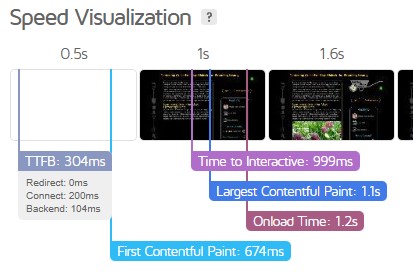
Let me start the comparison “Automation vs WordPress and Elementor Pro” with Kristian, a client of mine. She writes a blog on gardening, which is called Garden Like A Master, and uses WordPress and Elementor Pro.
One of her posts is Gardening Guide For May. As you can see from the image below, the Largest Contentful Paint takes 1.1 seconds:
The real killer is the page load speed on Mobile, as you can see by looking at another customer of mine:
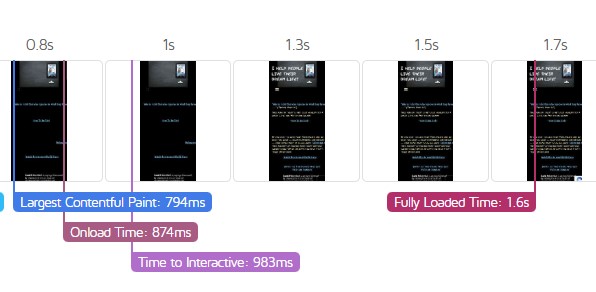
I want to stress that the Mobile page load speed you see for The Rbbi Who Got Rich On Sunday is only achievable after it has been optimized, which shows you the bloat from WordPress and Elementor Pro.
The screenshot below shows the Mobile page load speed numbers for the homepage of The Speed Of Profit:
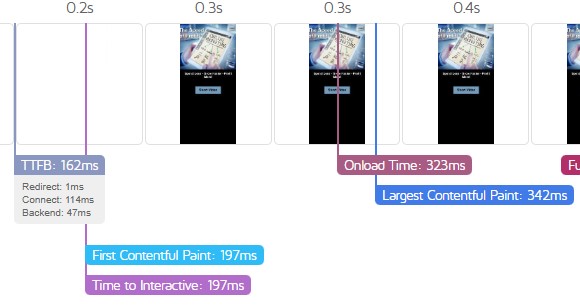
The numbers we are concerned with are FCP (first contentful paint), LCP (largest contentful paint) and TTI (time to interactive). As you can see, the Mobile page load speed of The Speed Of Profit is lightning fast. The site is interactive in under two-tenths of a second, and the LCP is complete in way under 4-thenths of a second.
The Rabbi Who Got Rich On Sunday took 983ms to be interactive (nearly a second), while The Speed Of Profit was interactive in 197ms, which is 5 times faster!
Since Page Load Speed is a part of UX, or User eXperience, which are ranking factors, two things hit you over the head instantly:
Significant speed increases help you outrank your competition. The people landing on your site will not bounce when they can see it that fast!
I want to be clear that if my content creation required me to code HTML, like I did before 2005, I would not switch to the method in services from The Speed Of Profit. The effort would not be worth it.
However, with automation, almost anything is possible, including rendering and deploying web pages without having to learn HTML!
In future posts, I will dig deeper into the categories we touched on above and delve into the improved security of static HTML pages.
Let me leave you with these two talking points:
As long as you have the automation, static HTML (JavaScript & HTML uploaded through an API) is faster to create than visual drag-and-drop page builders, and: Static HTML pages load way faster, cutting down the bounce rate and improving page rank on search engines, which increases traffic (more potential buyers/followers)!
There really is no comparison, which brings me to the question asked my the title of this website:
Yes, mindblowing page load speed is on the other side of WordPress!